HOW WE MEASURE
We measure pain.
Then we measure again.
Most clinics ask you to rate your pain on a 1-to-10 scale. That number changes with your mood, your sleep, the weather, and whether your boss yelled at you that morning. It is not a measurement · it is a vibe. We do not run a vibes-based clinic.
Every patient in our program is scored on five objective domains at intake, at the phase gates, and at discharge. We turn "I feel better" into a number we can defend.
We discharge by score · not by calendar.
THE PROBLEM WITH "HOW DO YOU FEEL?"
Chronic pain rewires the brain to lie about itself.
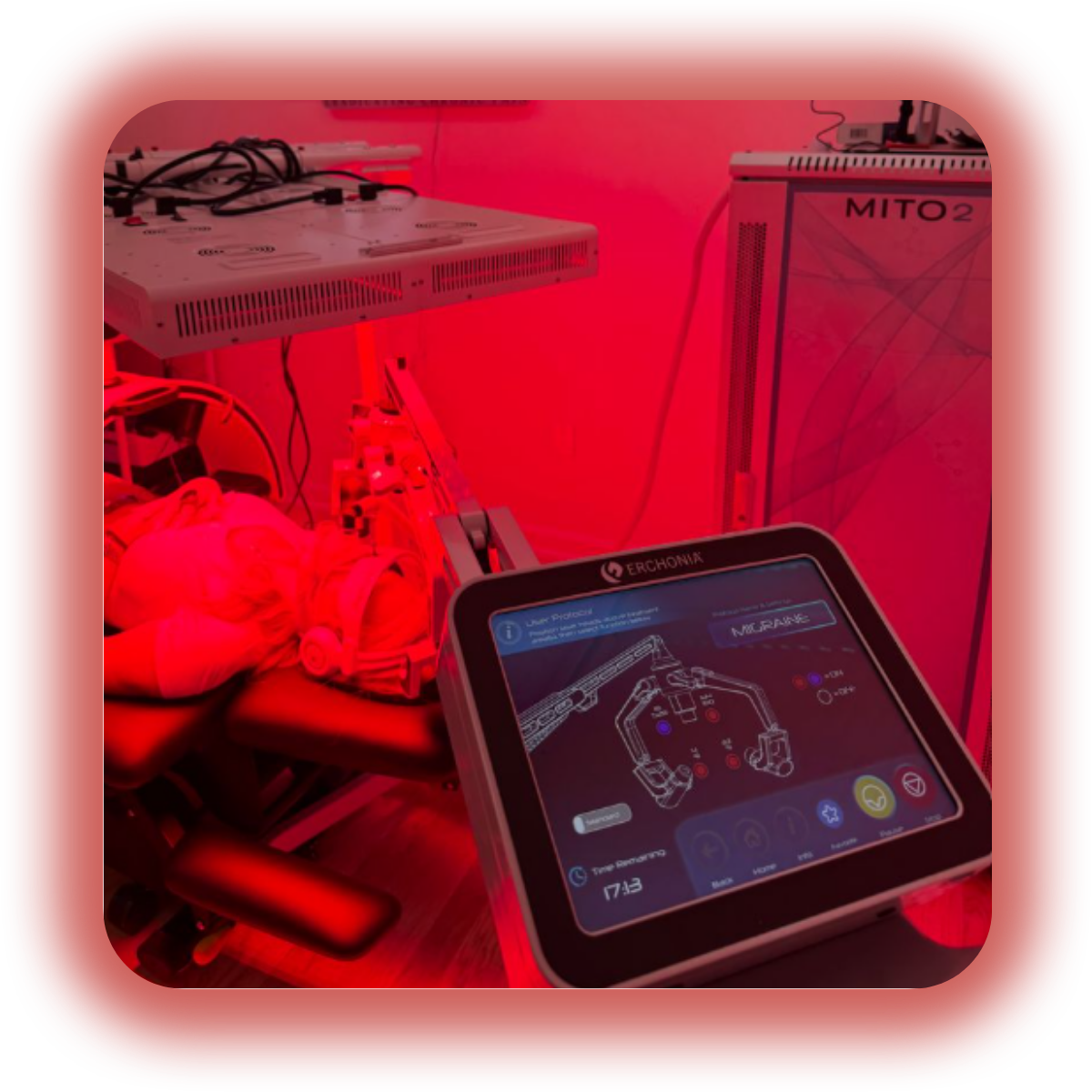
After months or years of pain, the nervous system amplifies signals that should be quiet and quiets signals that should be loud. Your perception of pain becomes uncoupled from what is actually happening in the tissue. This is why a patient with a perfect MRI can still hurt every day · and why a patient with a "bad" MRI can be totally pain-free.
Asking that patient to rate their pain on a 1-to-10 scale every visit will not tell us whether the program is working. It will only tell us how they feel today.
We measure five things that do not lie · brain wave patterns on a qEEG, autonomic nervous system tone on a WAVI, the structural cascade on a 3D posture scan, muscle function on EMG, and movement quality on dynamic assessment. Numbers like these change before symptoms change. They tell us the program is working weeks before the patient feels it.
THE PRINCIPLE
Subjective relief is the goal. Objective change is the proof.
We want you to feel better. But we will not call the program a success until the numbers say so.
THE OPTIMAL VITALITY SCORE
One number. Zero to one hundred. Higher means worse.
The Optimal Vitality Score (OVS) is a composite score we calculate at every assessment point. It rolls up findings from all five domains into a single number from 0 to 100. Zero is "no measurable pain dysfunction." One hundred is "every system is screaming at once." Higher means worse.
Most new patients walk in with an OVS between 43 and 76. Our discharge target is below 20. That number is not a guess · it is the threshold above which patients still report meaningful pain interference, and below which they do not.
VISUAL TREATMENT (DEVELOPER NOTE)
Build this as a horizontal scale bar · 0 on the left (green), 100 on the right (deep red). Mark "Typical intake range · 43-76" with a brand magenta band. Mark "Discharge target · below 20" with a brand green band. Add a small note · "Higher = worse."
IMPORTANT
OVS is not a pain rating
OVS is not your pain on a 1-to-10 scale. It is a composite of objective findings across brain, nervous system, structure, movement, and chemistry. Two patients can both rate their pain "8 out of 10" and have very different OVS scores.
WHAT WE MEASURE
Five domains. One composite OVS. Every patient. Every re-measure.
The OVS score rolls up five domain sub-scores. Each domain is measured with specific instruments at intake, at progress checks, and at full re-exams. The developer should render each domain as a card with its name, abbreviation, what it measures, and the instrument used.
IPS · INTEGRATED PAIN SCORE
How much pain is interfering with your life
One of the five domain sub-scores that feed the OVS roll-up. The IPS captures the patient-reported pain interference component · how much your pain affects work, sleep, movement, mood, and daily function. Lower = less interference.
FHS · FUNCTIONAL HEALTH SCORE
How well you function in daily life
Captured from the intake questionnaire and re-administered at every progress check and re-exam. Asks about sleep, mood, mobility, activity tolerance, work capacity, and medication burden. Lower = better function.
MPS · MOVEMENT & POSTURE SCORE
How your body is built and moves
Captured from the Spine 3D scan, PostureScreen analysis, PodoScan foot pressure mapping, and dynamic movement assessment. Identifies the structural cascade · which compensation is driving which pain. Lower = better mechanics. Visual scans (postural, mobility) are also done on every visit as quick progress checks.
DMS · DIAGNOSTIC & MODALITY SCORE
What is happening at the tissue level
Captured from EMG, thermography, range-of-motion testing, and provocative orthopedic tests. Tells us whether the muscle, joint, or soft tissue is the local driver. Lower = better tissue function.
NCS · NEUROLOGICAL & COGNITIVE SCORE
What your brain and nervous system are doing
Captured from qEEG (brain wave patterns), WAVI (heart rate variability and autonomic tone), and cognitive screening. Tells us how much of the pain is being amplified in the central nervous system. Lower = better central regulation.
WHEN WE RE-MEASURE
Every visit. Every month. Full re-exam as indicated.
We do not measure on a fixed calendar. The program runs through a Pain Protocol phase (1-3 weeks of nervous system calming) followed by the 12 Weeks to Better Posture program (months 1, 2, 3). Measurement happens continuously · postural, pain, mobility, and neuro visual scans are part of every clinic visit. IPS and functional scores are re-measured monthly as a function check-in. Full five-domain re-exams are performed as clinically indicated · not on a fixed week.
RE-TEST SCHEDULE
- Intake · full five-domain baseline (IPS · FHS · MPS · DMS · NCS) feeding the OVS roll-up
- Every visit · progress check · postural, pain, mobility, and neuro visual scans
- Monthly · function check-in · IPS + functional scores re-measured to confirm direction
- As indicated · full five-domain re-exam · ordered by Dr. Mark T. Wade or Dr. Krista Burns when the clinical picture warrants it
- Discharge · final five-domain re-exam and signed OVS score from both doctors
- Post-discharge check-in · optional 30-day and 90-day FHS recap (no charge) to verify durability
WHAT HAPPENS WHEN THE NUMBERS MOVE
We do not guess.
We follow the score.
At each re-measure we compare the new scores against the baseline and against the prior reading. The decision tree below tells the clinical team what to do next. The patient is shown their numbers at every gate. The first major gate is the transition from Pain Protocol into the 12 Weeks to Better Posture program · we require the patient to drop to 3/10 pain for 3 consecutive days before adding the structural load of 12WBP.
PAIN PROTOCOL GATE · 3/10 FOR 3 DAYS
Patient is ready for 12WBP
The first true gate. When the patient's pain has dropped to 3/10 or below for three consecutive days, the nervous system is calm enough to tolerate the rebuild work. We transition from Pain Protocol into the 12 Weeks to Better Posture program. Typically 1-3 weeks in.
OVS DROPPED 15+ POINTS
Strong response · advance the protocol
We continue forward as planned. Patient sees the curve and we celebrate the progress. We do not change what is working.
OVS DROPPED 5-15 POINTS
Partial response · diagnose the lag
We look at which sub-scores moved and which did not. If MPS lagged, we add structural work earlier. If NCS lagged, we extend the brain-calming stack before adding load. We do not advance until the lagging domain catches up.
OVS DROPPED LESS THAN 5 POINTS
Weak response · case conference
We pause and run a case conference between Dr. Wade and Dr. Burns. We may add a modality, re-image, or refer for specialist co-management. We do not add new protocol load until we understand why the program is not working as expected.
OVS UNCHANGED OR RISING
Honest conversation
We sit down with the patient and tell them what we are seeing. We give them three options · adjust the protocol with a new working diagnosis, refer out to a specialist, or end the program with a refund of unused care under our published refund policy. We do not extend the program to chase numbers that are not moving.
WHAT PROGRESS LOOKS LIKE
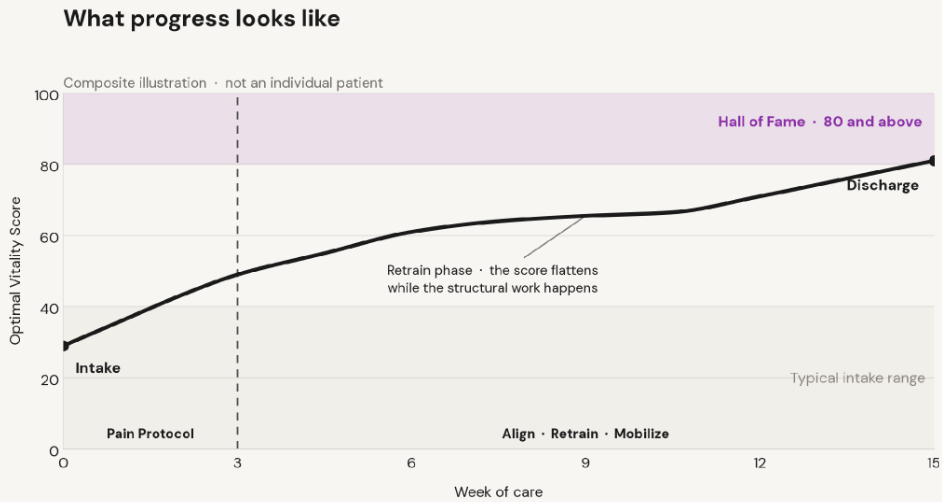
A composite curve. De-identified. The shape every patient should see.
The chart below is a composite based on common patient presentations · it is not a single real patient's data. It shows the shape of an Optimal Vitality Score across a course of care, starting low at intake and climbing toward the Hall of Fame threshold of 80. The largest early gains usually come during the Pain Protocol and the Align phase, as the nervous system starts to calm. The Retrain phase often looks like a plateau, because the structural work has not yet shown up as a change in symptoms. The Mobilize phase brings the final climb.
DISCLAIMER
Composite case example based on common patient presentations
The case examples on this site are composite illustrations built from common chronic pain patterns we see and the typical outcomes our program is designed to produce. They are not testimonials from specific patients. Individual results vary based on the severity of the condition, the patient's commitment to the program, and clinical factors. Past results are not a guarantee of future outcomes. All clinical decisions are made on a case-by-case basis by Dr. Mark T. Wade and Dr. Krista Burns after a full exam.
WHAT WE PROMISE
If the numbers
don't move, we tell you.
Most clinics will keep selling you sessions as long as you keep showing up. That is not our model. Our entire program is built around a measured outcome. If at any re-measure the numbers say the program is not working for you, you will hear that from us before you hear it from your gut. We may adjust the protocol.
We may refer you to a specialist who can co-manage. Or we may end the program and refund unused care under our published refund policy. What we will not do is keep treating you in the hope something changes.
We measure. We measure again. And we tell you the truth either way.
· Dr. Mark T. Wade, DC, DrPH · Lead Clinician
NEXT STEP
Want your own baseline OVS score?
The Patient Interview is a 30-minute paid consultation where Dr. Wade or Dr. Burns walks you through what your full assessment would look like and whether you are a fit for the program. The fee is split · $200 at application and $200 only if accepted as a patient. We make the decision on the call · you will not have to wait two business days to hear back from us.

(727) 233-5268
Clinic@PostureClinic.com
6425 53rd St N Ste 6, Pinellas Park, FL 33781
We don't manage chronic pain. We eradicate it.
The Posture Clinic, a chiropractic practice.
© The Posture Clinic 2026. All rights reserved.